
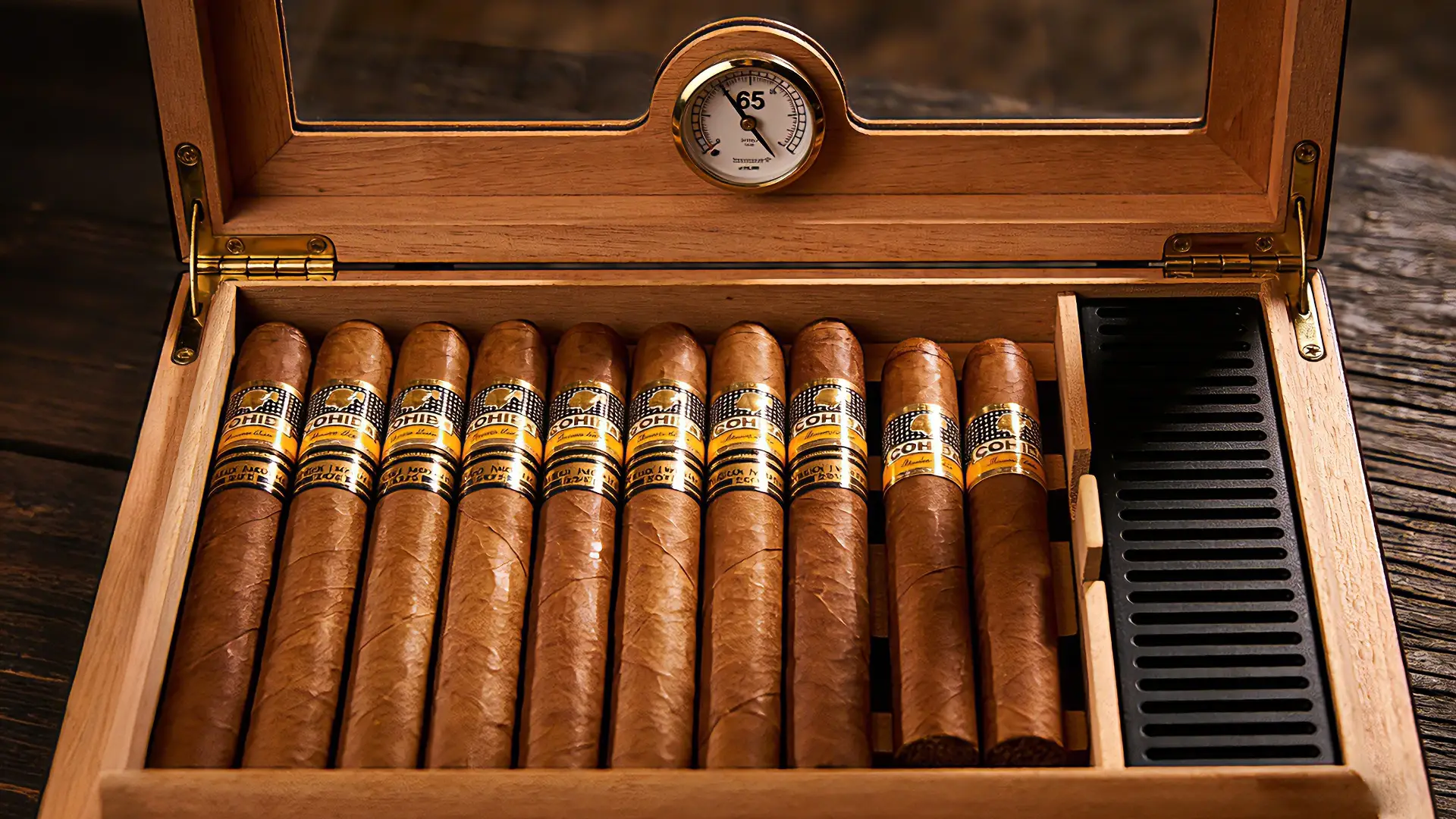
The Complete Beginner's Guide to Cigar Humidors
Table of Contents
If your cigars feel dry…
If humidity never stabilizes…
If your hygrometer keeps changing…
Your humidor is probably not seasoned correctly. Or worse, the humidor you bought might not even be made of real Spanish cedar—which will ruin your cigars.
This guide will show you exactly how professionals do it. From selection to seasoning your cigar humidor and beyond.
Introduction: Why Your Cigars Need a Proper Humidor
If you’re new to the world of premium cigars, learning how to season a cigar humidor properly is the most important first step. A well-seasoned humidor creates the perfect environment for your cigars to age and stay fresh, while an unseasoned one will quickly dry them out. This complete guide will walk you through everything from selecting the right humidor to troubleshooting common issues.
But with so many options on the market, how do you choose the right one? And once you have it, how do you set it up correctly? This guide will walk you through every step—from selecting the perfect humidor for your needs, to unboxing and inspecting it, to seasoning it properly, and finally troubleshooting common issues—so you can enjoy perfectly preserved cigars for years to come.
Part 1: How to Choose the Right Cigar Humidor
Why Spanish Cedar Is the Best Material?
The material your humidor is made of is the single most important factor affecting its performance. While you may see humidors made from various woods or even acrylic, Spanish cedar is the gold standard for one simple reason: it naturally regulates humidity.
Advantages of Spanish Cedar over other woods:
| Feature | Spanish Cedar | Other Woods (e.g., Pine, Oak, Particle Board) |
|---|---|---|
| Humidity Regulation | Naturally absorbs and releases moisture, buffering against swings. | Poor moisture retention; can warp or crack. |
| Aroma | Imparts a pleasant, aromatic scent that enhances cigar aging. | May have strong odors that taint cigars (e.g., pine). |
| Insect Repellent | Contains natural oils that repel tobacco beetles and other pests. | No such protection. |
| Durability | Stable and resistant to warping when properly maintained. | Prone to swelling, splitting, or glue failure (particle board). |
| Moisture Absorption | The open grain allows it to absorb and distribute moisture evenly. | May absorb too quickly or unevenly. |
How to Tell If Your Humidor Is Made of Real Spanish Cedar?
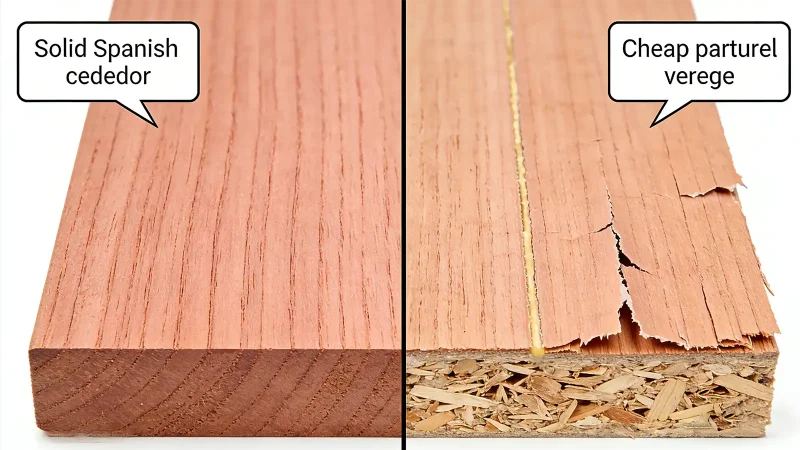
With the growing popularity of premium humidors, some lower-quality models use cedar veneers or other woods disguised as Spanish cedar. Here are four simple ways to verify you’re getting the real thing:
1. The Smell Test (Most Reliable)
Real Spanish cedar has a distinct, pleasant aroma—often described as a mix of cedarwood, cinnamon, and spice. Open an empty drawer or compartment and take a deep sniff. If you smell strong chemical odors, paint, or nothing at all, it’s likely not solid Spanish cedar.
2. The Grain and Color
Spanish cedar has a straight, even grain with a color ranging from pale pinkish-brown to a deeper reddish-brown. The wood should look natural and uniform. Beware of:
Perfectly uniform, light-colored wood – may be basswood or pine with a cedar stain.
A thin wood layer glued onto particle board – check the edges of drawers or shelves; if you see a different material underneath, it’s not solid cedar.
3. The Weight Test
Solid Spanish cedar is surprisingly lightweight for its size. If the humidor feels unusually heavy, it may be made of cheaper, denser woods like mahogany or oak, or it may have a particle board core.
4. The Water Test (Advanced)
Place a tiny drop of water on an unseen area of the wood. Real Spanish cedar will absorb it slowly and evenly. If the water beads up or sits on the surface, the wood may be sealed or finished, which defeats the purpose of a humidor.
Remember: A quality humidor should be lined with solid Spanish cedar, not just cedar-scented or cedar-veneered materials. Taking a few minutes to verify before you buy can save you years of frustration.
Still Worried About Getting the Real Thing?
We understand—with so many options on the market, it can be hard to know what you’re really getting. That’s why every Tesonway humidor is proudly crafted from 100% solid Spanish cedar—no veneers, no particle board, no shortcuts.
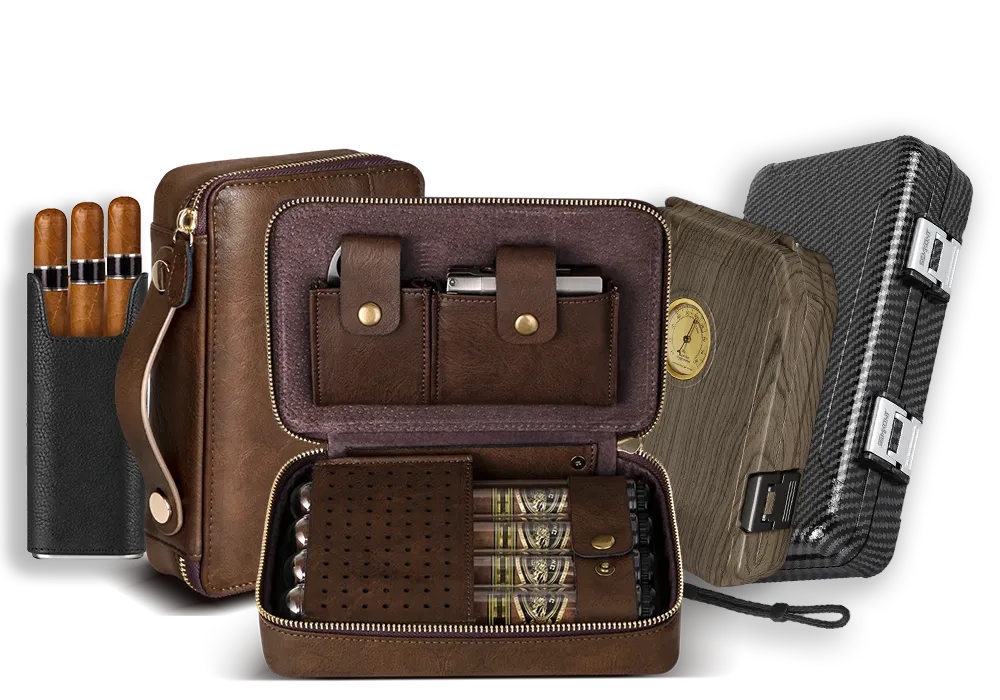
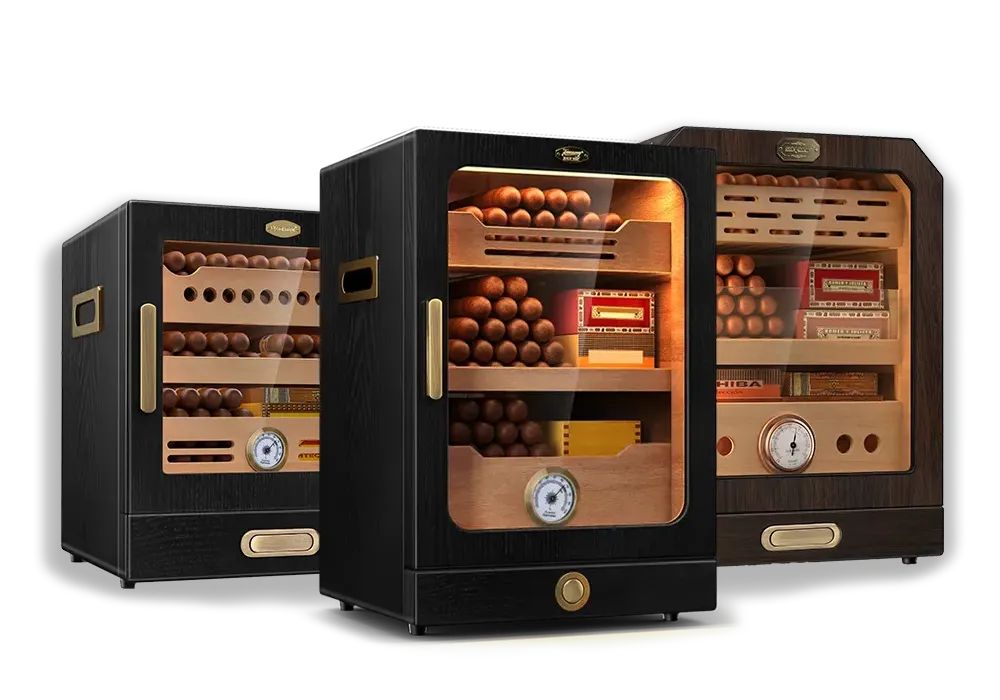
Whether you’re just starting with a travel humidor, building your collection with a desktop model, or investing in a cabinet for long-term aging, you can buy with confidence knowing your cigars are protected by genuine Spanish cedar.
Explore our collection:

Bottom line: Always choose a humidor lined with solid Spanish cedar. Avoid cheap models made of particle board or other woods, as they will never perform as well.
How to Choose the Right Size for Your Collection?
As a beginner, your cigar collection will grow. It’s wise to think ahead, but also practical to start with a size that fits your current needs.
| Humidor Type | Typical Capacity | Best For |
|---|---|---|
| Single Cigar Tube / Travel Humidor | 1–3 cigars | Short trips, carrying a single cigar for the day, sampling. |
| Travel Humidor (Small) | 5–10 cigars | Weekend trips, small gatherings, beginners with a few cigars. |
| Desktop Humidor | 15–50 cigars | Daily use, home storage for the average enthusiast. Perfect for building a small collection. |
| Cabinet Humidor | 100–300+ cigars | Serious collectors, aging large quantities, long-term storage. |
Pro Tip: Buy Slightly Bigger
Cigar collections have a funny way of growing fast! A 10–35 count desktop humidor is the perfect starting point for most beginners—it gives you room to explore without feeling cramped.
For a reliable, beautifully crafted option made from solid Spanish cedar, check out the Tesonway Glass Top Desktop Humidor. It's designed to hold 10-35 cigars, features a precision hygrometer, and comes ready to season.
View This Humidor →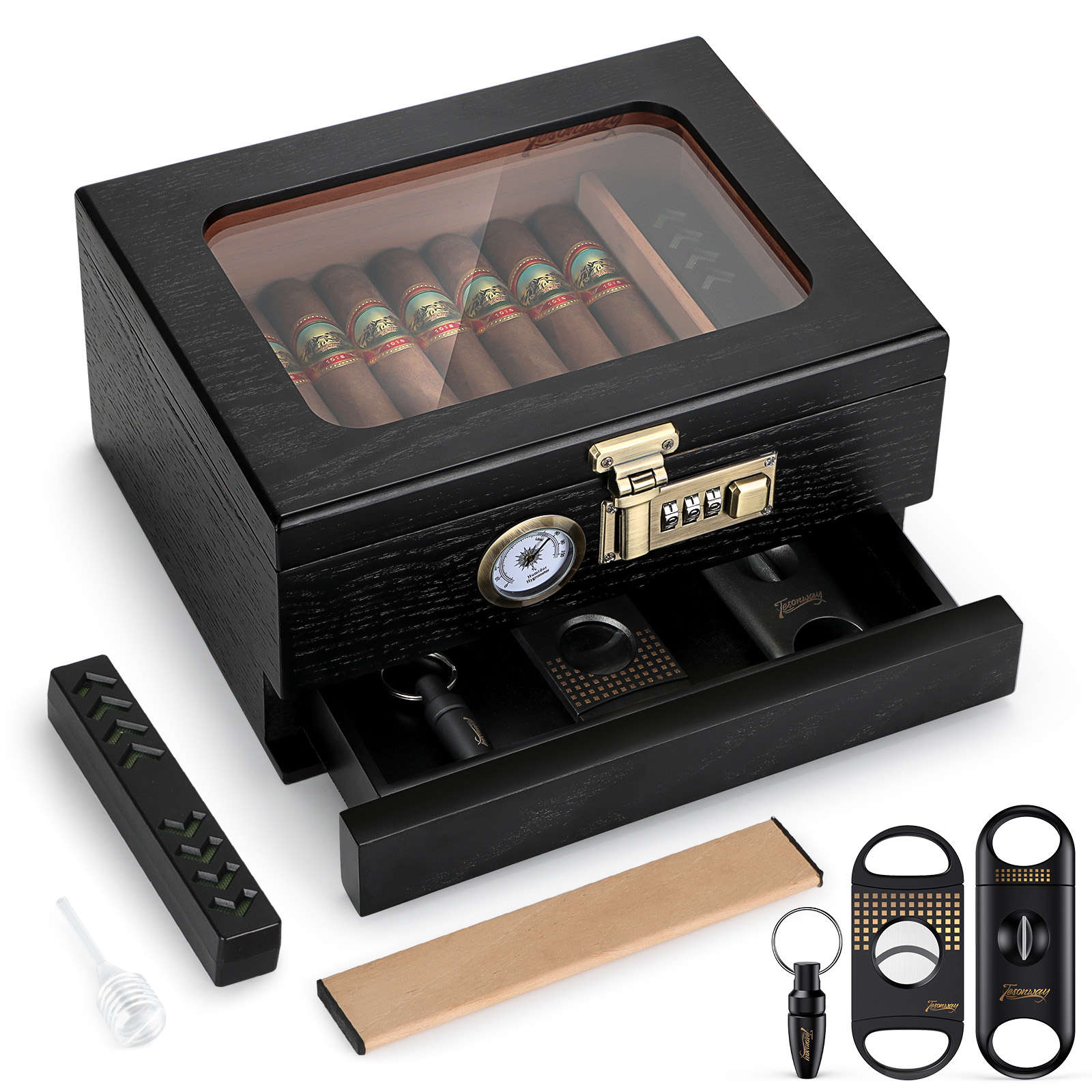
What to Look for in a Quality Humidor
Solid Spanish cedar lining (not just a cedar sheet glued to particle board).
Airtight seal – the lid should close with a slight “whoosh” of air.
A reliable hygrometer – preferably one that can be calibrated.
A good humidification system – either a built-in passive humidifier or space for Boveda packs.
Solid construction – no loose parts, smooth drawer slides, etc.
Part 2: The First Thing to Do When You Receive Your Humidor – The Light Test
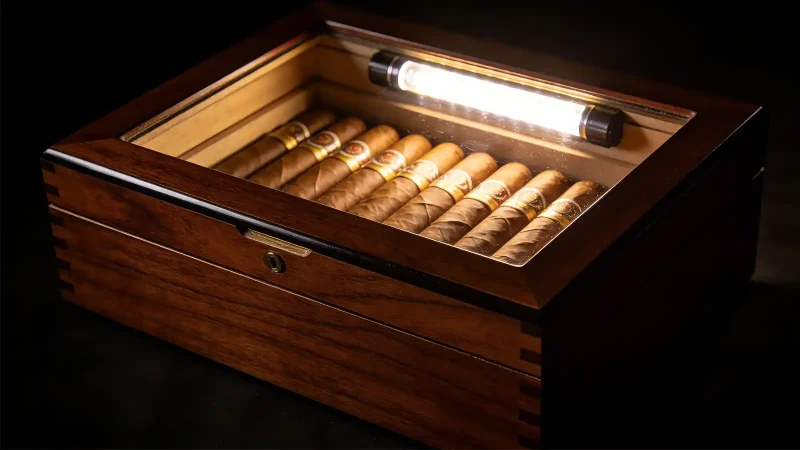
You’ve just unboxed your beautiful new humidor. Before you even think about seasoning it, there’s one critical test that can save you weeks of frustration: checking the seal.
A humidor that doesn’t seal properly will never hold stable humidity, no matter how carefully you season it. Finding a seal defect now means you can get a replacement before wasting time.
How to Perform the Light Test
Take your empty humidor into a completely dark room (a closet or bathroom at night works well).
Place a lit flashlight (your phone’s flashlight is perfect) inside the humidor and close the lid securely.
From the outside, slowly inspect all four edges of the lid where it meets the body. Look for any light escaping – even the faintest glow.
What Your Results Mean
| Test Result | Interpretation | Recommended Action |
|---|---|---|
| No light visible anywhere | Excellent seal. You can proceed with confidence. | Continue to seasoning. |
| Bright, obvious light leaks | Significant manufacturing defect. The humidor will never hold humidity. | Contact us immediately for a replacement. Include a photo or video of the light leak with your order number. |
| Very faint, intermittent light | Possible minor misalignment. Sometimes gentle pressure on the lid can improve the seal. If the leak persists after adjusting, it may still cause humidity loss. | Try pressing firmly on the lid edges and retest. If faint leak remains, you can attempt seasoning but monitor closely. If humidity won’t stabilize after a full 7‑day season, a replacement will be needed. |
Why this test matters: A humidor with a poor seal is like a bucket with a hole – you can keep pouring water in, but it will never stay full. Identifying this early saves you time and protects your cigars from future damage.
Part 3: How to Season a Humidor?
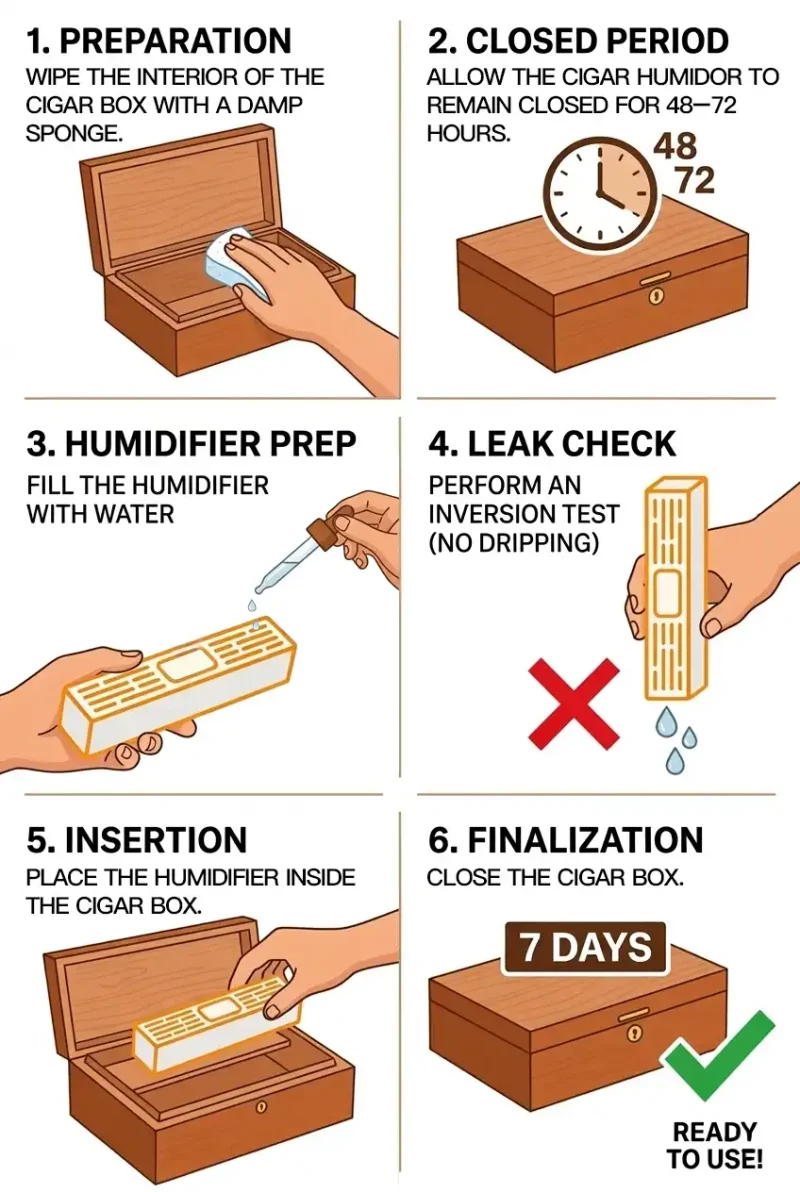
If your humidor passed the Light Test, you are ready to learn how to season a cigar humidor through our proven 7-day process.. For our official, more detailed step‑by‑step seasoning guide, please refer to this article: How to Season a Tesonway Humidor. Below are the core steps distilled from that guide and our customer service experience—follow them precisely.
Step 1: Prepare the Cedar Surfaces
Remove all items from your humidor including trays humidifier and hygrometer,using a lint‑free, clean cloth (never paper towels), gently wipe all interior Spanish cedar surfaces. Pay special attention to joints and corners where dust and manufacturing residue may accumulate. This ensures the wood can absorb moisture evenly.
Step 2: Hydrate the Interior Properly
Soak a soft sponge in 100% distilled water only (tap or bottled water contains minerals that will damage the cedar and clog your humidifier over time).
Wring it thoroughly until it is damp but not dripping – no water should run off the sponge.
Wipe all internal surfaces evenly, including the underside of the lid, the bottom, and any drawers or trays.
Rule: Note the wood will begin to change color and become darker be careful not to over saturate your humidor there, Never leave standing water on the wood. should not be any puddles on the inside too much water can warp the wood, too little water won’t give your humidor the kickstart that it needs to maintain the 70% humidity.
Step 3: The Drying Phase
Place the tray back inside close the lid and let it sit for 24 hours, the reason for this is to allow the inside of your humidor to settle down and reach a reasonably in a stable environment:
Ideal temperature: 18–21°C (65–70°F)
Keep away from direct sunlight, heating vents, air conditioners, and drafty areas.
Rapid temperature changes during this phase can ruin the seasoning process.
During this time, the wood will slowly absorb the moisture and begin to regulate humidity naturally.
Step 4: Prepare Your Humidifier Correctly
After 24 hours have passed open the humidor and reinstall the humidifier and the calibrated hygrometer, close the lid for another 24 hours, you want to give all your components a chance to acclimate to the humidity inside the box. This is the most common point of failure – follow exactly:
Fill your humidifier with distilled water (or a 50/50 mix of distilled water and food‑grade propylene glycol for better long‑term stability).
Fully saturate the internal sponge until it is completely wet.
The Essential “Upside‑Down” Test:
Gently turn the humidifier upside down over a sink.
If any water drips out → it is OVERFILLED. Wipe away the excess until no drips occur.
If no water drips and the sponge feels damp → it is correctly filled.
Wipe the exterior of the humidifier completely dry to prevent water spots on your future cigars.
Why this matters: An overfilled humidifier can cause mold; an underfilled one won’t provide enough moisture during seasoning. Getting this right is the key to success.
Step 5: Adjust the humidifier placement.
Place the correctly prepared humidifier inside your humidor:
Position it centrally, away from where cigars will eventually rest.
For larger cabinets, place it on an upper shelf to allow moisture to circulate evenly.
Ensure it sits upright and that its vents are unobstructed.
Step 6: The Final Sealed Wait – till the humidor ready
Close the humidor securely and do not open it for next 2 full days. This uninterrupted period is absolutely critical. The cedar needs continuous time to absorb moisture and reach a stable equilibrium. Opening the lid even once during this week will reset the process and require starting over.
Summary: The 7‑Day Seasoning Checklist
Day 1: Wipe interior with damp (not wet) distilled‑water cloth.
Day 2–3: Leave humidor to air‑dry (48‑72 hours). Do not open it:)
Day 4: Fill humidifier correctly (passes upside‑down test). Place inside.
Day 5–6: Seal humidor and do not open.
Day 7: Open and check hygrometer – should read 65‑72%. If not, troubleshoot using the guide above.
Important Note:
- In high-humidity regions (e.g., coastal or tropical areas), aim for a level closer to 68% RH to prevent excess moisture that can dull cigar flavor or promote mold.
- In dry climates (e.g., desert or arid zones), target a level near 72% RH to counteract rapid moisture loss from the cedar wood and your cigars.
Do I Have to Wait the Full 7 Days to Season My Humidor?
7 Common Mistakes Beginners Make When Seasoning a Humidor
Even with the best intentions, small errors during seasoning can lead to weeks of frustration. Here are the most frequent mistakes we see—and exactly how to avoid them.
1. Using Tap Water (or Bottled Water)
The mistake: Filling your humidifier with tap water, spring water, or even filtered drinking water.
Why it’s wrong: These waters contain minerals (calcium, chlorine) that will eventually clog your humidifier’s pores, leave white residue on your cedar, and promote mold growth.
The fix: Always use 100% distilled water. It’s chemically pure H₂O with no additives. Your cedar and your cigars will thank you.
2. Opening the Lid During the Seasoning
The mistake: Peeking inside after a day or two “just to check.”
Why it’s wrong: The cedar needs uninterrupted time to absorb moisture and reach equilibrium. Opening the lid releases the built‑up humidity and essentially resets the clock. You’ll have to start over.
The fix: Close it and walk away for 7 full days. Mark your calendar if you have to. No peeking.
3. Overfilling the Humidifier
The mistake: Soaking the sponge until water pools in the bottom or drips everywhere.
Why it’s wrong: An overfilled humidifier can’t breathe properly—it leads to stagnant water, mold, and uneven humidity. Water may also leak onto the wood, causing warping.
The fix: After saturating the sponge, gently turn the humidifier upside down over a sink. If any water drips out, it’s too wet. Wipe away the excess until it’s merely damp. It should pass the “no‑drip” test.
4. Underfilling the Humidifier
The mistake: Adding just a splash of water and calling it done.
Why it’s wrong: A barely damp sponge can’t release enough moisture to season the cedar. You’ll end up with humidity stuck at 50‑55% and wonder why nothing works.
The fix: Fully saturate the sponge until it’s uniformly wet, then perform the upside‑down test to remove only the excess. It should feel heavy and damp, not dry.
5. Adding Cigars Too Early
The mistake: Loading your cigars right after you fill the humidifier.
Why it’s wrong: Cigars themselves absorb moisture. If you add them before the cedar is fully seasoned, they’ll compete with the wood for every drop of humidity—and they’ll lose. Your cigars will stay dry and the humidity won’t stabilise.
The fix: Wait until after the 7‑day seasoning is complete and the hygrometer reads a steady 65‑72%. Then introduce your cigars gradually.
6. Chasing an Exact 70% Reading
The mistake: Obsessing over getting the hygrometer needle exactly on 70%, and constantly adjusting or refilling to “fix” it.
Why it’s wrong: The ideal range for cigars is 65‑72% RH. A steady 66% is just as good as 70%. Small daily fluctuations are normal. Over‑adjusting actually prevents the environment from stabilising.
The fix: Once you’re inside the 65‑72% window, leave it alone for a few days. If it holds steady, you’re done. Trust the process, not the exact number.
7. Placing the Humidor Near a Heat Vent or Window
The mistake: Keeping your newly seasoned humidor on a shelf directly above a radiator, next to an AC vent, or in a sun‑struck window.
Why it’s wrong: Temperature swings and constant airflow will suck humidity right out of the wood, undoing all your hard work. Even a perfectly sealed humidor can’t fight a drafty location.
The fix: Choose a spot with stable temperature (18‑21°C / 65‑70°F) and no direct sun or air currents. A quiet corner of a bedroom or living room is perfect.
Avoid these seven pitfalls, and your humidor will reward you with years of perfect cigar storage.
If you need a refresher on the full seasoning process—including the light test and step-by-step instructions—go back to the main guide above.
Part 4: Long‑Term Maintenance for a Perfectly Seasoned Humidor
Once your humidor is seasoned and stable, regular care will keep it that way.
| Frequency | Task |
|---|---|
| Weekly | Quick visual check of hygrometer reading. |
| Every 2‑3 weeks | Check humidifier moisture level; refill if needed (always using the “no drip” standard). |
| Monthly | Light interior wipe with a distilled water‑dampened cloth to refresh the cedar. |
| Quarterly | Deep clean with a cedar‑safe solution if needed (avoid any chemicals). |
Always avoid: Tap water, chemical cleaners, and overfilling the humidifier.
Part 5: When to Request a Replacement
If you have:
Completed a full 7‑day seasoning correctly.
Confirmed your humidifier is filled properly (no drips, fully saturated).
Performed the Light Test and found no light leaks.
Still cannot maintain stable humidity (above 65%) after 7 days.
…then your humidor may have a manufacturing defect not visible to the eye. Contact our support team with:
Your Amazon order number.
Photos of your setup (humidifier placement, hygrometer reading).
A short video of the Light Test (showing no leaks).
We will verify and provide a warranty replacement promptly.
With this complete guide, you now know how to season a cigar humidor and maintain it for years to come. you now have both the official seasoning process and the real‑world troubleshooting knowledge to keep your cigars perfectly preserved. Happy smoking!
Part 6: Troubleshooting Common Humidor Humidity Problems
Even after learning how to season a cigar humidor correctly, you may encounter issues. Here are the most common problems.
Problem: Humidity Stuck Below 60% After Seasoning
Likely causes and solutions:
The humidifier is underfilled (most common).
Recheck your humidifier using the “upside‑down test.” If it feels only slightly damp, refill it until it is fully saturated but still passes the no‑drip test. An underfilled unit cannot provide enough moisture.
Your humidor is full of cigars.
A full humidor places much higher demand on the humidification system because the cigars themselves absorb moisture, competing with the cedar.
Solution:
Check and refill your humidifier every 2‑3 days during the first 1‑2 weeks.
Add one or two 72% Boveda packs alongside your main humidifier for supplemental moisture.
Be patient – full humidors take longer to stabilize.
The seal has a very minor leak (even if the initial light test was clean).
Sometimes a seal can be slightly compromised after the wood expands during seasoning.
Re‑perform the Light Test now. If you see faint light, try pressing firmly on the lid edges to improve contact.
If the leak persists, the unit may need replacement.
Room humidity is extremely low.
If your home is very dry (e.g., winter heating), the humidor will lose moisture faster.
Solution: Use a room humidifier near the humidor, or add extra Boveda packs inside.
Problem: Boveda Packs Dry Out Much Faster Than Expected
Boveda packs are designed to last 2‑4 months in a properly sealed humidor. If they are drying out in days or weeks, it almost always means the humidor is leaking air.
Action:
Perform the Light Test again. Any light visible confirms a leak.
If a leak is confirmed, contact us for a warranty replacement (include a video of the light test).
Problem: The Hygrometer Reading Seems Inaccurate
Many built‑in analog hygrometers need calibration. Here’s how to do it:
Gently remove the hygrometer from its mounting.
Locate the small calibration screw on the back (usually a flathead slot).
Using a small screwdriver, turn the screw to adjust the needle to 65%.
Blow gently through the calibration hole – the needle should move, confirming it’s working.
Reinstall and allow 24 hours for recalibration.
For a more accurate check, place a known‑accurate digital hygrometer inside for 8‑12 hours and compare readings.
Problem: My Humidity Stays at 60-65% – Should I Worry?
Many new humidor owners become anxious when the hygrometer reads 63% instead of the “ideal” 70%. Let’s put this in perspective.
The ideal range for cigars is 65‑72% RH. This is a range, not a single number. A steady reading of 65% is perfectly acceptable and will keep your cigars in excellent condition. Some premium cigars are even stored closer to 65% by experienced collectors. The key word here is stable – a consistent humidity within that range is far more important than chasing a specific number like 70%.
If your humidor consistently reads between 62‑68% but does not drop further, consider these factors:
Is the humidity stable? If it holds steady at, say, 63% day after day, and your cigars feel well‑humidified (not brittle or cracking), you may not need to take any action at all. Many cigars smoke beautifully at 63‑68%.
Is the humidor fully seasoned? If you’ve only just completed the 7‑day seasoning, it can take another week or two for the cedar to fully acclimate, especially if you’ve added cigars. Give it time.
Is your humidifier properly filled? Re‑check the “upside‑down test.” Even a slightly underfilled humidifier can hold you at 63% instead of 68%. Refill if needed.
Is the seal perfect? Perform another Light Test. Any faint light could be the reason you’re not reaching the upper part of the range.
Is the room dry? If your home humidity is very low (e.g., 30‑40%), the humidor will naturally struggle to reach higher numbers. In that case, adding an extra Boveda pack or two can help boost the humidity a few points.
When should you take action?
If the humidity is dropping over time (e.g., from 65% to 62% to 59%), that indicates a problem (leak, underfilled humidifier, or incomplete seasoning).
If your cigars feel dry, brittle, or are losing flavor, you need to address the humidity.
If the humidity is stable but below 60%, that’s too low and requires correction.
In summary:
A steady 63% is not a crisis. If your cigars are happy and the number isn’t falling, you can relax. If you’re aiming for 68‑70%, try adding a second Boveda pack or checking your humidifier fill more carefully. But never panic over a few percentage points – stability is the true goal.
Facing Humidity Issues After Seasoning?
Even after proper seasoning, sometimes humidity problems can still arise. If your humidor won't hold stable humidity, our troubleshooting guide can help you identify and fix the issue quickly.
Check out the full guide: How to Fix Humidor Humidity Problems
Read the Guide →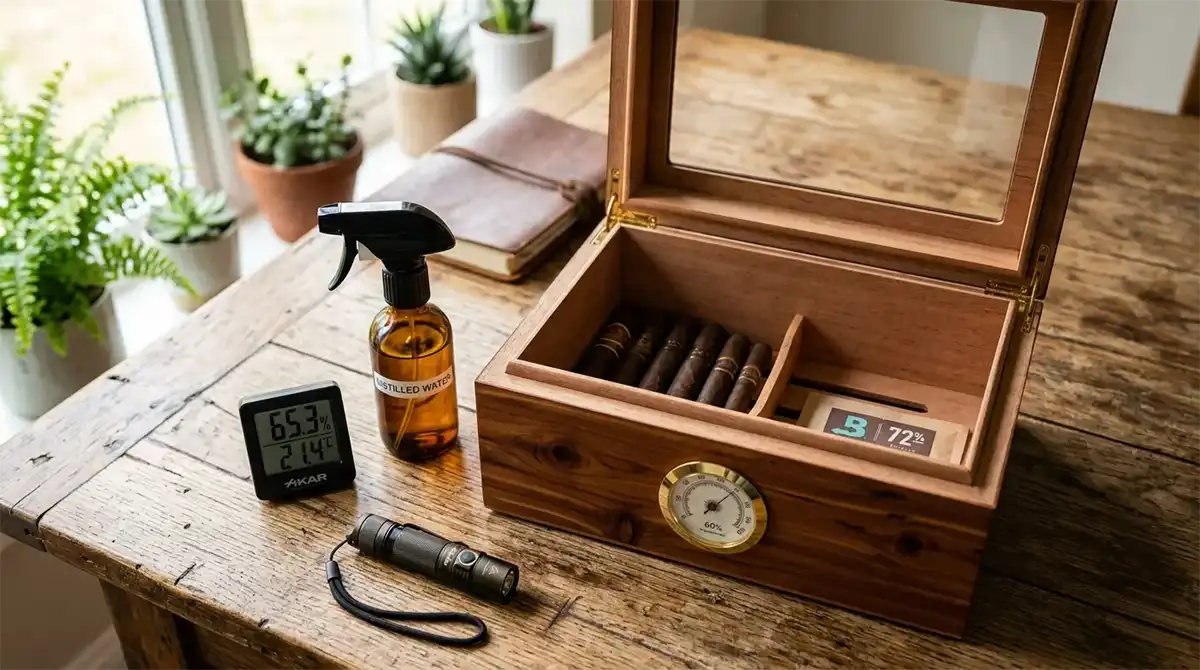
Frequently Asked Questions
Still have questions? Here are the most common questions beginners ask about seasoning a cigar humidor:)
How long does it take to season a cigar humidor?
Seasoning usually takes 24-72 hours depending on the humidor size and humidity level. Proper seasoning ensures stable humidity before storing cigars.
Do I need distilled water to season a humidor?
Yes. Always use distilled water to prevent mold, mineral buildup, and damage to the Spanish cedar interior.
Can I season a humidor with tap water?
No. Tap water contains minerals and bacteria that may cause mold growth and affect cigar flavor.
what humidity level should a seasoned humidor reach?
A properly seasoned humidor should stabilize between 65-72% relative humidity. Percent the type of climate you live in makes a big difference, you live in an area with high humidity, recommended target humidor close to 65-68%. If you live in an area with low humidity, recommended target humidor close to 68-72%.
Should I wipe the inside of the humidor?
Lightly wiping the interior with a damp cloth is optional, but avoid soaking the wood to prevent warping.
How do I know if my humidor is fully seasoned?
Normally, when humidity remains stable for at least 24 hours without fluctuations, the humidor is ready for cigars.
Can Boveda packs be used for seasoning?
Yes. Boveda seasoning packs offer an easy and safe alternative without the risk of over-humidifying.
What happens if I skip seasoning?
Skipping seasoning may cause cigars to dry out, lose flavor, or crack due to unstable humidity.